Products · Key systems
Key systems for multi-unit storage
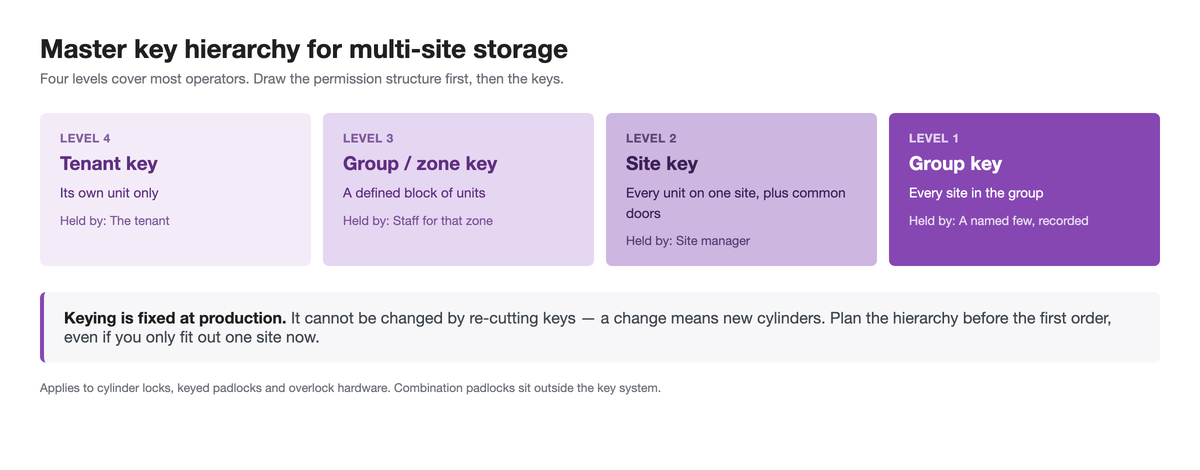
Keying is the one part of the specification that cannot be corrected after production. Plan it once, record it, and every future replacement still matches the keys your tenants already hold.
Choose your configuration
A key-system order starts from the keying rule, then the keyway, the blank profile and the quantity per group.
- Keyed alike
- One key opens a defined group of units
Suits small facilities or groups under one operator. Trade-off: a lost key exposes the group. - Keyed different
- Every unit has its own key
Suits maximum tenant separation. Trade-off: more keys to manage. - Master / manager key
- Tenant key opens its unit; manager key opens the site or group
Suits multi-site operators and any facility with an overlock routine. Needs planning before production. - Overlock keying
- Manager key operates overlock hardware
Planned on the same schedule as the unit cylinders. - Re-order path
- Stored specification and key plan
A cylinder ordered in three years still matches existing keys.
Specification
Category parameters for key systems. Keyway, blank profile and keying schedule are confirmed once the unit list is agreed.
| Structures | Keyed alike · keyed different · master key · manager key |
|---|---|
| Applies to | Cylinder locks, keyed padlocks and overlock hardware on the same schedule |
| Not applicable to | Combination padlocks — no key cylinder |
| Planning inputs | Unit count per site, total across sites, uniqueness requirement, manager key quantity and scope, lost-key policy, overlock requirement |
| Documentation | Key plan recorded per site and stored against your specification |
| Re-order | Produced against the stored plan so later orders match existing keys |
| MOQ | From 500 pcs — keying schedules confirmed with the quotation |
| Sample | From 5 days |
| Batch production | Around 30 days after spec and artwork confirmation |
| Trade terms | EXW · FOB · CIF · CFR · DDP |
Keyways and blanks are confirmed with the keying schedule. A published blank list would be less useful than checking the keyway your existing keys use.
Fit and compatibility
- Key systems apply to cylinder locks, keyed padlocks and overlock hardware — all planned on one schedule.
- Combination padlocks are outside the key system: there is no cylinder to key.
- Keying is fixed at production. Changing it afterwards means replacing cylinders, not re-cutting keys.
- Plan overlock keying at the same time as unit keying so one manager key covers both.
Fit is a keyway question. Send one existing key or a photo of both sides, and we confirm whether it matches a keyway we cut and which keying options apply.
Ordering information
Terms for key systems. The keying schedule is the document that matters most: it is agreed in writing, then held for future key and cylinder orders.
- MOQ
- From 500 pcs
Where a new keyway has to be cut, that is quoted separately from the locks and cylinders that use it. - Samples
- From 5 days
Sent with the keying schedule, so you can test key action against a lock from the same batch. - Batch production
- Around 30 days after spec and artwork confirmation
Key cutting and cylinder keying run together, so the schedule is confirmed before the holiday shutdown. - Delivery terms
- EXW · FOB · CIF · CFR · DDP
Keys and cylinders are dense and high-value, so the document set often matters more than the freight mode. - Payment
- T/T · L/C · Credit card
Key-schedule orders follow the standard terms; the schedule is issued with the order confirmation rather than after the deposit. - Documentation
- Spec sheet, inspection record, packing list, pre-shipment photos
Key and cylinder records are issued against the keying schedule, so a re-order produces keys that match the originals.
Send the unit list and who needs access at each level, and the quotation will carry the keying schedule as well as the price.
Options and customization
Key-system options that do not change the keyway — key quantity per group, key stamping, colour coding and packaging.
Key plan document
We return a written key plan with your quotation: which key opens what, and how many of each.
Manager key scope
One key for a single site, or a group-level key across multiple sites, depending on your requirement.
Lost-key policy
Decide at planning stage whether a lost tenant key means rekeying the unit or accepting the exposure until move-out.
Re-order continuity
The plan is stored, so a replacement cylinder ordered years later is produced to the same keying.
Quality and evidence
What a key system is checked against, and what stays on file so keys still match in three years.
SGS
Verified supplier
On-site audit completed October 2025.
ISO 9001
Quality system
Incoming, in-process and final inspection.
Plan
Written key plan
The keying schedule is recorded against your account, not kept in an email.
Re-order
Continuity
A cylinder ordered later is produced to the same keying as the first order.
Buyer questions
Which key structure should a facility use?
There is no single answer. Keyed alike suits a group of units under one operator. Keyed different gives maximum tenant separation. A master key suits any site where a manager needs access. Most facilities end up with a mix. Tell us the unit count and who needs access and we will propose a plan.
Can keying be changed after production?
No. Keying is set when the cylinders are assembled, so a change means new cylinders rather than re-cut keys. That is why we plan it before the order rather than after.
How many manager keys should we order?
Enough to cover normal operations plus a documented reserve. Tell us how many staff need site access and whether you need a group-level key, and we will size it with the key plan.
Do padlocks and cylinders share a key plan?
They can, and usually should. Keying both families on one schedule is what prevents a site from ending up with padlocks on one key and cylinders on another.
Can you supply a replacement cylinder years later?
Yes, provided the original key plan is on file with your specification. That is the main reason we document it — a cylinder ordered three years later matches the keys your tenants already hold.
Related families:
Send us your door type and unit count
Send the unit list and the access rules. You will get a keying schedule, a key count and a price — typically within 4 business hours.