Products
Self-storage lock and door hardware range
Eight hardware families cover a self-storage facility from the tenant unit door to the manager's overlock routine. Specification and fit are confirmed against a physical sample before production.
Why this range, and not a catalogue
A supplier with 5,000 products is not more useful than one with eight. These families exist because a self-storage site keeps asking the same four questions — what goes on the tenant's door, what happens when nobody holds a key, what holds a roll-up door closed, and how a vacant unit is secured.
| The site needs | Family | Why it is in the range |
|---|---|---|
| A lock on the tenant's unit door | Disc padlocks · cylinder locks · padlocks | Three door conditions — hasp, cylinder cut-out, or a non-standard door — need three different answers, not one padlock |
| Access without issuing a key | Combination padlocks | Some operators would rather not run a key register at all |
| A roll-up door that stays latched | Roll-up door latches and hasps | A padlock cannot fix a door whose latch or hasp is the weak point |
| A unit visibly out of service | Overlock and lockout hardware | Vacant and delinquent units need a different device from a tenant lock |
| Operator access across the site | Key systems | Keyed-alike groups and manager keys decide how the whole site is run |
| An electronic option | Smart padlocks | Added for sites where issuing and chasing keys is the actual problem |
What is not in the range matters as much: we do not supply door closers, handles, hinges, screws or general building hardware. If your project needs those, we will say so rather than quote something we do not make.
01 · Unit doors
Disc padlocks
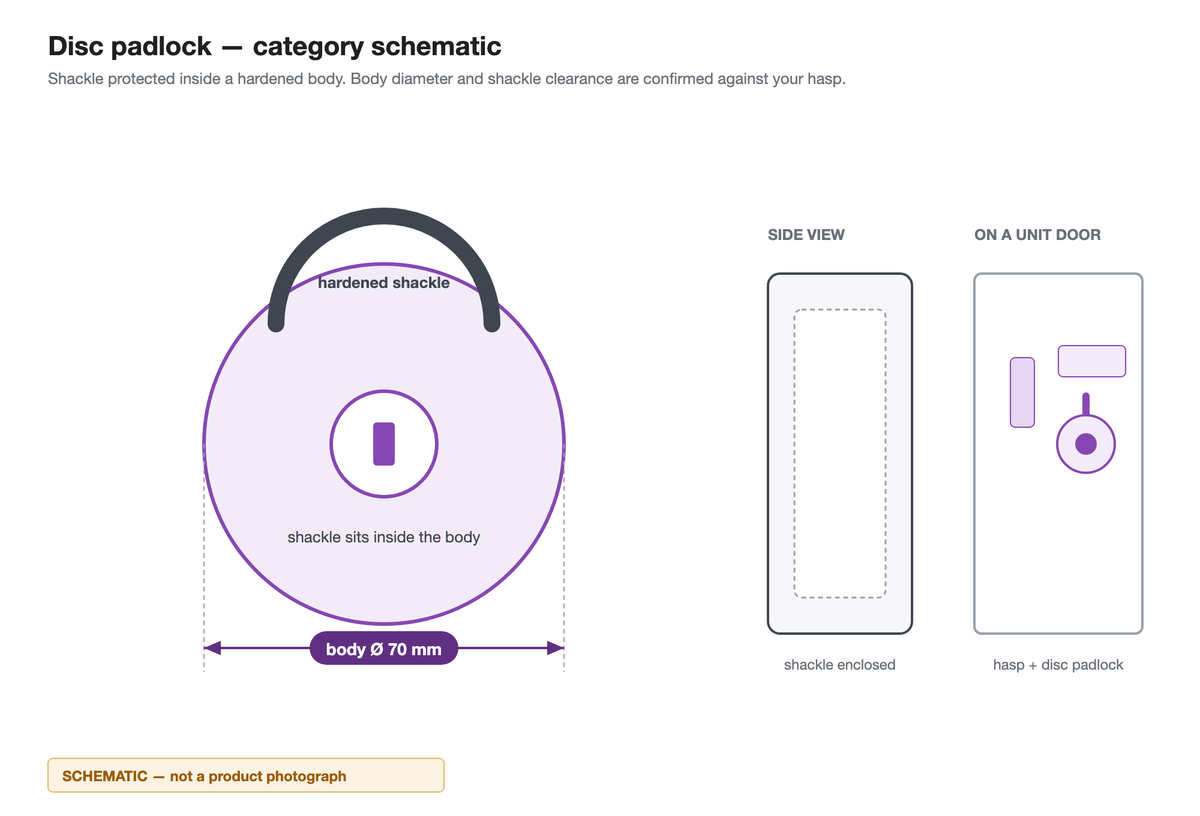
A disc padlock protects the shackle inside a hardened body, which makes it far harder to attack with bolt cutters than a standard padlock. For storage units that means less theft risk — and less time spent on unit security.
- Body
- Hardened stainless disc, 70 mm
- Key system
- Keyed alike · keyed different · master key
- Material
- SS201 for indoor and covered corridors · SS304 for exposed and coastal sites
- Branding
- Laser logo on body and keys · unit-level serial numbers
- Packaging
- White box · blister card · printed box · bulk pack
- Fit
- Standard self-storage unit doors — confirmed with a physical sample
02 · Replacement and standardisation
Cylinder locks
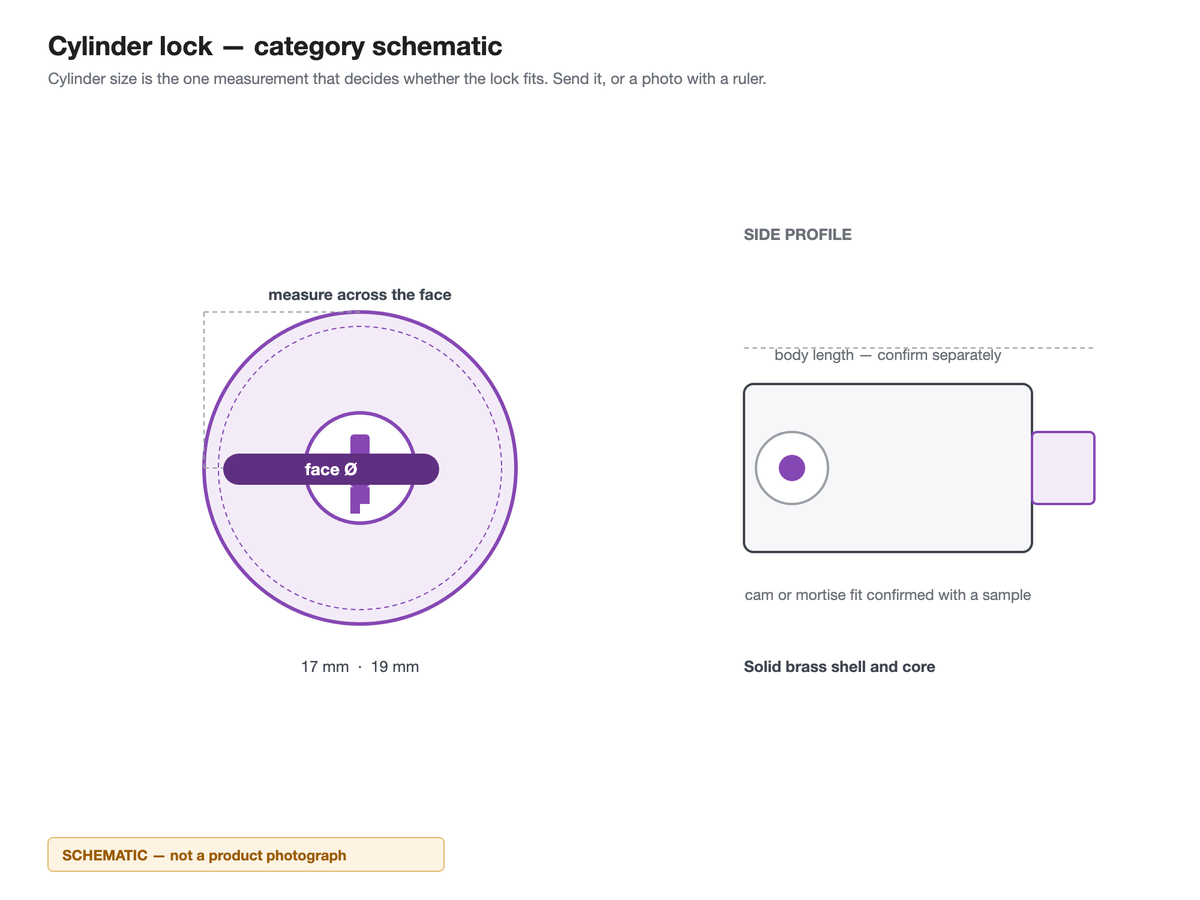
Most facilities start with whatever locks were available. A few years later nobody can say which key opens which unit. A standard cylinder and a documented key plan fixes that permanently.
- Body
- Solid brass, 19 mm and 17 mm
- Key system
- Keyed alike · keyed different · master key · manager key
- Suits
- Replacing mixed cylinders with one standard
- Documentation
- Key plan per site, so a replacement cylinder still matches the original keys
Combination padlocks
Resettable numeric combination — no keys to issue, replace or chase when a tenant moves out.
No key management
Nothing to cut, issue or replace when a tenant leaves.
Resettable code
Code changed between tenancies without changing the lock.
Ready to issue
Factory-set models arrive with a code already set, so a unit can be handed to a tenant the same day.
Combination padlocks do not use a key system, so keyed-alike and master-key options do not apply to this family.
Padlocks
Not every door takes a disc padlock. This family covers the padlock types a self-storage site needs outside the standard unit door.
Disc
The usual choice for a unit door fitted with a hasp.
Laminated steel
Where a disc body will not fit the hasp or the door gap.
Shrouded / hidden shackle
Where the exposed shackle is the weak point.
04 · Roll-up and swing doors
Roll-up door latches and hasps
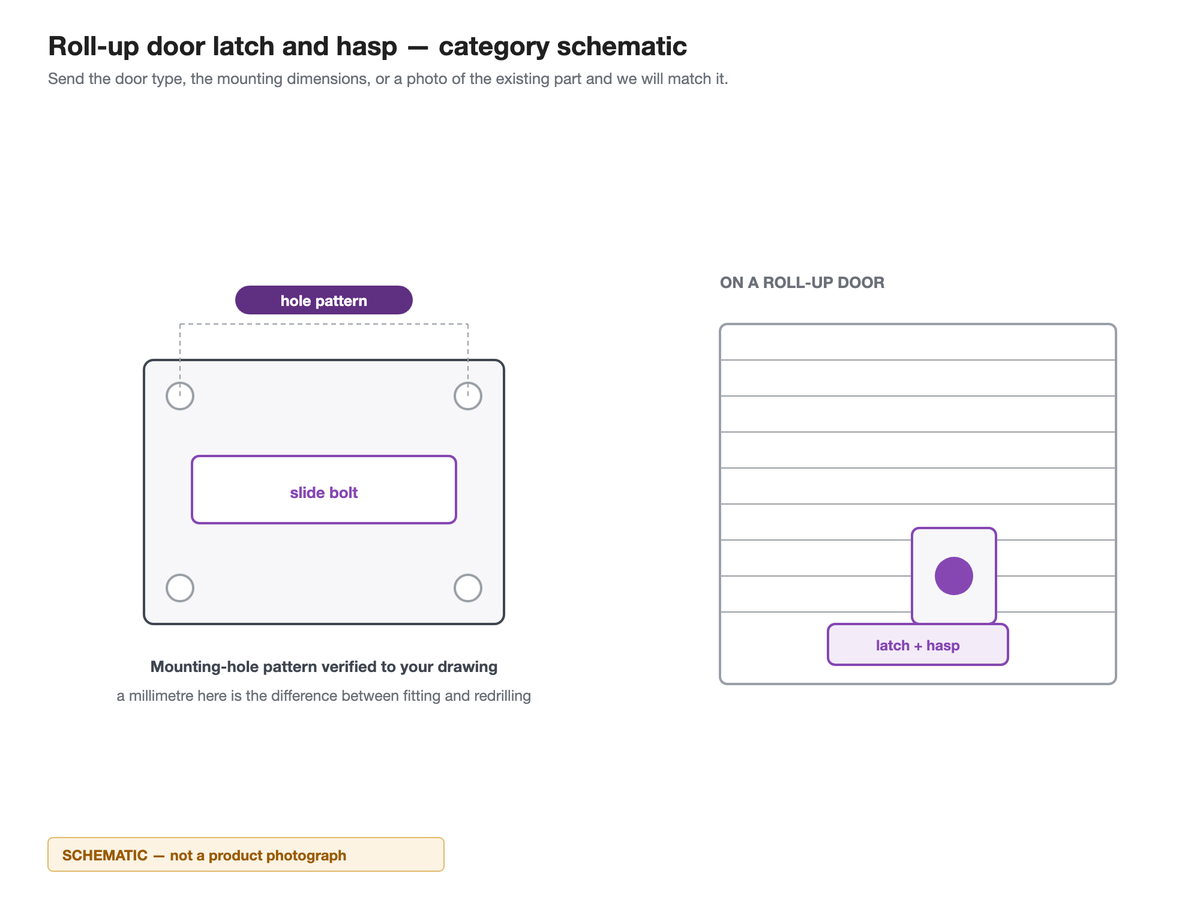
Slide bolt latches, hasps, latch guards and mounting hardware for roll-up and swing doors. This is the family where a millimetre of hole pattern decides whether the part fits.
- Products
- Slide bolt latches · door hasps · latch guards · mounting plates · return springs
- Mounting
- Punched to drawing; hole pattern verified before the full run
- Finish
- Zinc plated or powder coated
- Fitment
- Send your door type, mounting dimensions or a photo of the existing part
05 · Operations
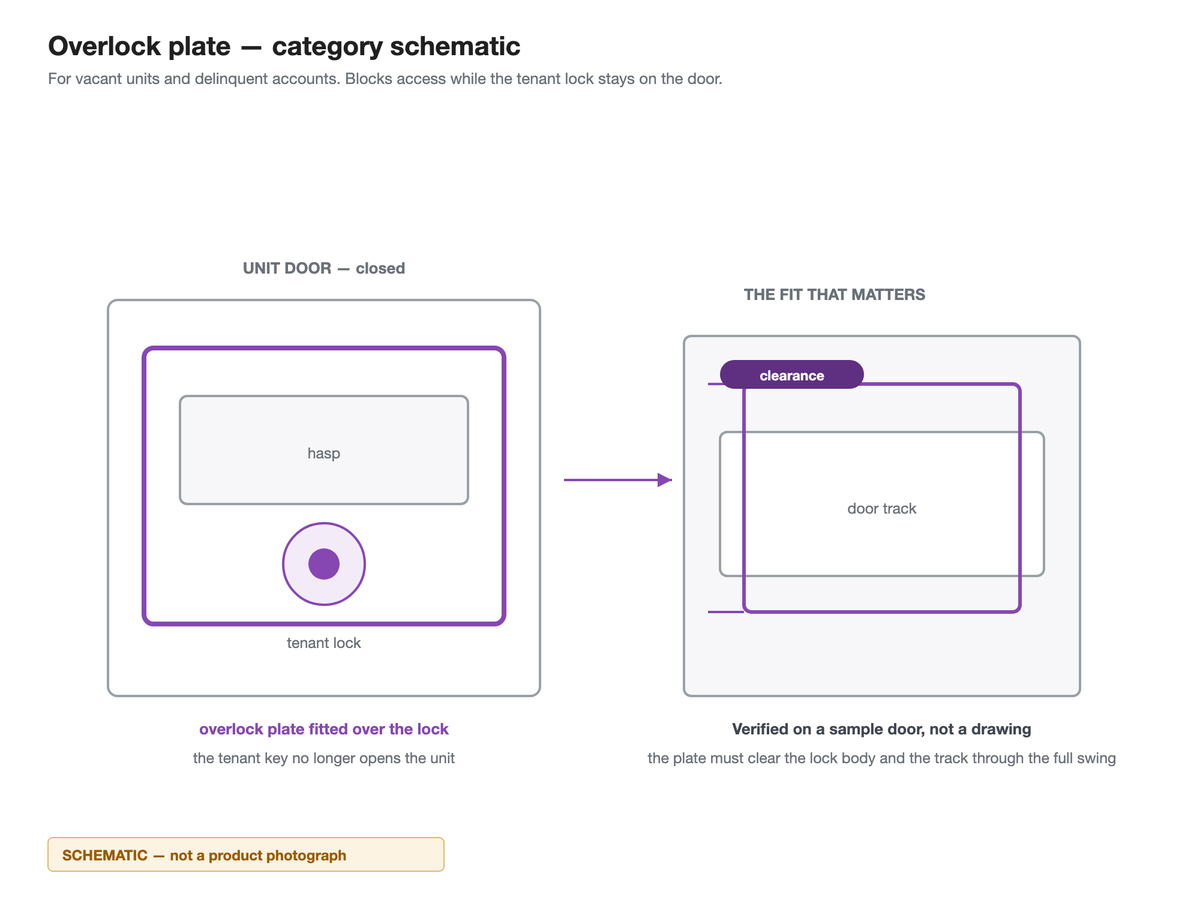
Overlock and lockout hardware
Hardware for the part of the job nobody puts in a brochure — vacant units, delinquent accounts and units that must not be opened without a manager present.
- Products
- Overlock plates · lockout brackets · latch protectors · manager locks
- Designed for
- Vacant units and delinquent accounts
- Fit
- Must clear the lock body and door track through the full swing — verified against a sample door
- Keying
- Manager keys can overlock every unit on a site or across a group
Key systems
Three ways to structure a facility key plan, and the trade-off each one carries.
Keyed alike
One key opens a defined group of units.
Suits: small facilities, or groups of units under one operator.
Trade-off: if one key is lost, the whole group is exposed.
Keyed different
Every unit has its own key.
Suits: maximum tenant separation.
Trade-off: more keys to manage and replace.
Master key / manager key
Each tenant key opens only its own unit. A manager key opens every unit, every unit on one site, or every site in a group.
Suits: multi-site operators and any facility with an overlock routine.
Trade-off: needs planning before production.
How we plan it with you
- Unit count per site and total across sites
- Whether tenant keys must be unique
- How many manager keys, and what each one should open
- What happens when a tenant key is lost
- Whether vacant units need overlock hardware
Send those five answers and we will come back with a key plan and a quotation.
Smart padlocks
Bluetooth and fingerprint access, for sites that would rather not issue keys or chase them at move-out.
Bluetooth app
Time-limited e-keys issued from the app, with an access record.
Fingerprint
50 prints enrolled at the lock, so the record names the person.
Mechanical key backup
Opens the lock when the battery is flat.
Product range questions
How do I choose between a disc padlock and a cylinder lock?
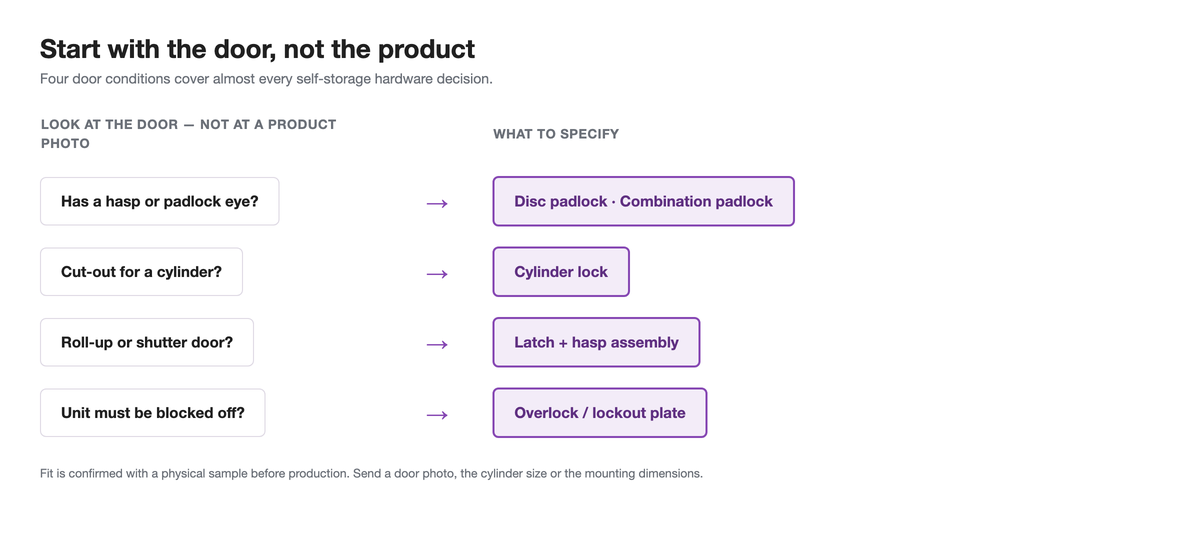
It depends on the door. Unit doors with a hasp normally take a disc or combination padlock. Doors with a mortise or cam lock take a cylinder. Roll-up doors take a latch and hasp assembly. Send a door photo and we will tell you which family fits.
Can I mix families in one order?
Yes. Mixed orders are consolidated in Wenzhou, which is usually cheaper than splitting the shipment across suppliers. Tell us the full list and we will quote it as one configuration.
Do you publish prices?
No. Price depends on material, quantity, customization and delivery terms — SS201 against SS304, white box against blister card, EXW against DDP. We quote your configuration so you can compare like for like.
Are detailed model pages available?
Model-level pages with dimensions, drawings and MOQ are being published family by family. In the meantime, send your specification and we will return the models that fit within one working day.
How many families does a typical facility need?
Most sites take two or three: a padlock or a cylinder lock for tenant units, a latch or hasp assembly for roll-up doors, and overlock hardware for vacant units. The mix follows the doors rather than a standard package.
Can we sample across families before choosing the mix?
Yes. Sampling several families before committing to the mix is normal, and sample lead time starts at five days. Tell us the door types and we will confirm which samples to send.
Not sure which family you need?
Send a photo of the door, the unit count and the destination country. We will confirm the family, the fit and the price.