Knowledge base · Technical note
How to measure a storage cylinder lock
Cylinder size is the one measurement that decides whether the lock fits. It takes about thirty seconds to check — and it is the single most useful thing you can send us.
Why this measurement matters more than any other
A storage cylinder lock has to seat into a cut-out that already exists in the door. If the diameter is wrong, the lock either will not enter the bore or will sit loose in it. No amount of adjustment on site fixes a wrong bore size.
It is also the first question we ask, because two suppliers quoting the same MOQ at different prices are usually quoting two different cylinder sizes.
Step 1 — identify the cylinder face
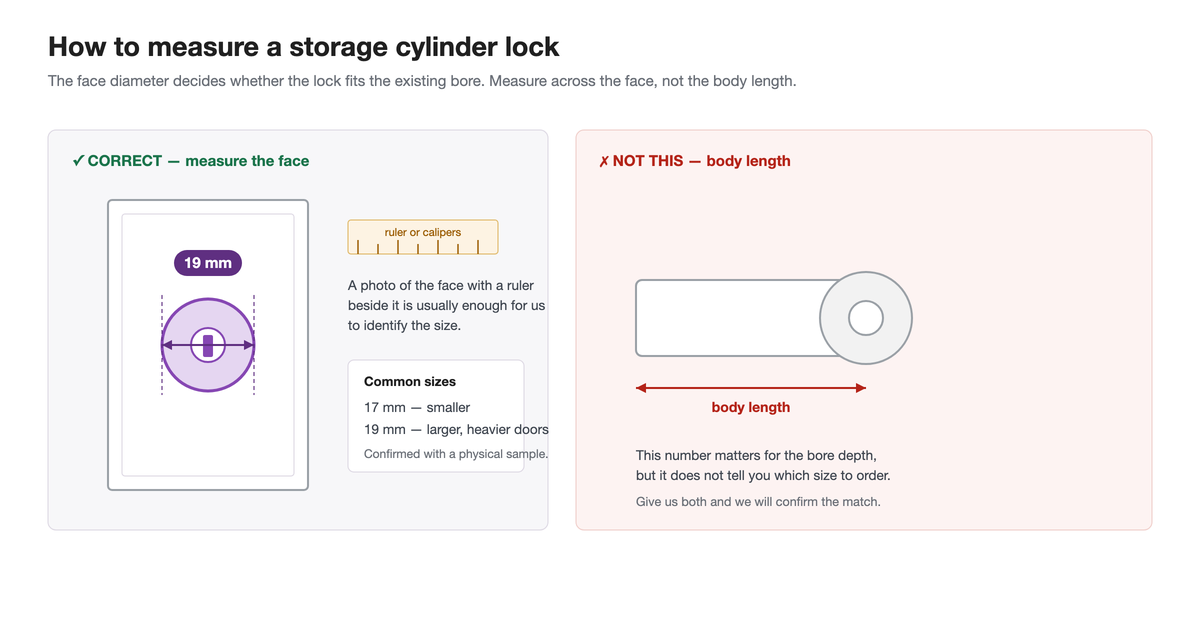
On the outside of the door you will see a round or oval plate. That plate is the cylinder face. It is the part the key enters. The measurement we need is across that face, not the length of the cylinder body inside the door.
Step 2 — measure across the face
Use a ruler or calipers across the widest part of the face.
- 17 mm — the smaller of the two common storage sizes.
- 19 mm — the larger size, more common on heavier doors.
The two sizes are visually close, which is exactly why a photo with a ruler beats an estimate every time.
Step 3 — photograph it with a ruler in frame
Place a ruler across the cylinder face and photograph it straight on, so the ruler and the face are both readable. The same photo usually tells us three things at once: cylinder size, the fixing arrangement, and whether the door has a cam or mortise cut-out.
From that one image we can normally read the size, the fixing arrangement and the cut-out type. A photograph settles the size; only a physical part settles the fit, so one is sent to test on the door before you order in volume.
When you cannot measure it
Sometimes the unit is occupied, or the door is a model you did not install. In that case send:
- A photo of the whole door from the outside
- The door manufacturer and model, if it is printed or stamped anywhere
- A photo of the existing cylinder, even without a ruler
We will tell you what we can determine and what still needs checking. We would rather send a sample than have you guess.
Common mistakes
- Measuring the body length instead of the face diameter — these are different numbers and both matter, but size selection starts with the face.
- Measuring an old cylinder that has been replaced before — a previous supplier may already have fitted the wrong size.
- Assuming all units on a site are identical. Sites built in phases often have two or three different cylinders. Measure a sample from each phase.
Confirm it on your own doors
Send a door photo, the cylinder size or the mounting dimensions. We confirm fit with a physical sample before you commit to a quantity.
What readers ask next
The photo is sent, and these are the next steps.
Can you send a sample if we cannot measure the cylinder?
Yes. Send a photo of the whole door and, if it is stamped anywhere, the door make and model. We send a physical sample for the size we identify so it can be tested on the door before any bulk order. Sample lead time starts at five days.
Is there a price difference between 17 mm and 19 mm?
The two sizes are quoted separately because material and production time differ. Both are quoted from the same enquiry so the comparison is like for like.
Our units came in three phases with different cylinders. Can one order cover all sizes?
Yes, one order can carry more than one size. Send the count per size and the minimum can be confirmed against the combined quantity before you commit.